

by Tonia "Toni" Moore
The South Carolina Historical Marker Program was officially established in 1936 “to have the direction, and control of the marking of historical sites, or houses and localities.”
South Carolina Historical Markers identify and interpret places of importance to achieve an understanding of South Carolina’s past. This includes sites of significant events, or at historic properties such as buildings, sites, structures; or as examples of institutions or individuals significant in local, state, or national history.
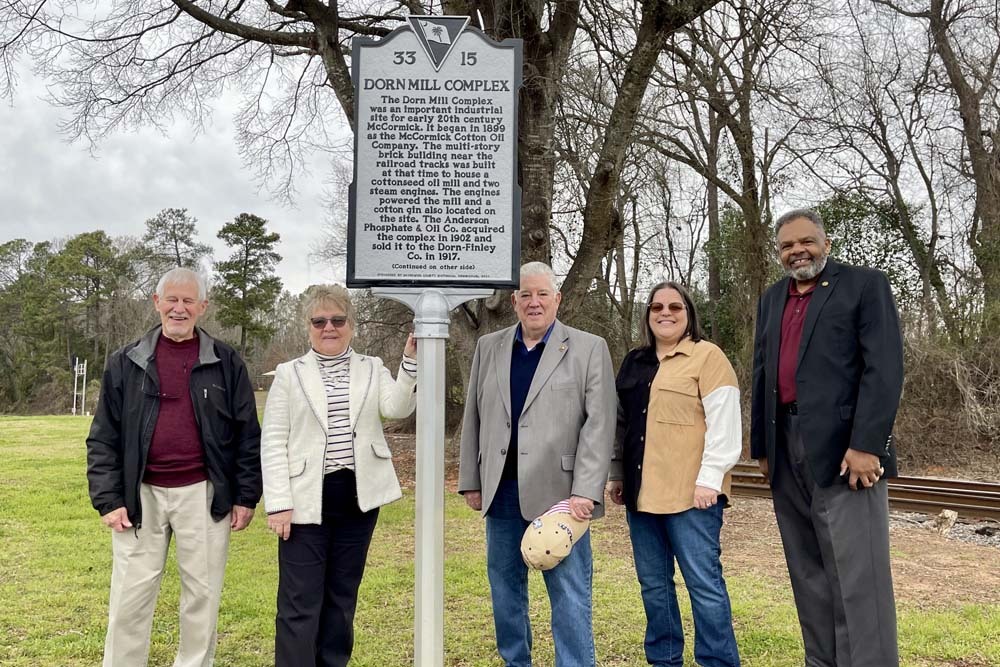
Recently, the Dorn Mill Complex Historical Marker was unveiled and joined approximately 1,900 other historical markers that have been approved and erected in South Carolina.
As you travel throughout the state, it might be of interest to you to note that the earliest markers, cast from 1936 to 1954, have a circular device at the top and feature a palmetto tree and the letters SC. These initial markers are gray with raised gray or black letters. Markers cast from 1954 to 1990 have a triangular shape centered at the top with a state flag and feature raised silver letters on dark blue markers. The most recent markers cast since 1990 are silver with raised black letters, as you will see were used for the Dorn Mill Complex marker now in place.
The South Carolina Historical Maker program receives no regular state funding and has always depended on the citizens of South Carolina to suggest, document, sponsor, maintain and pay for markers.
The McCormick County Historical Commission, commissioners Jim Brady, Marjorie Brosseau, George Patterson, and President Tonia Moore, welcomed a group of supporters to the marker dedication.
Brady acknowledged the many people and organizations who helped in this effort, including McCormick Mayor Roy Smith and the McCormick Town Council, Dolly Franklin, Nathan Jones, Calvin Chiles, Curtis Dansby, Alvin Jennings, and Fay Hood; along with funds from the Town of McCormick’s Business Incentive Grant. Also recognized were Clay and Beth Antonakos, owners of Lee Builders Inc., for their support in storing, transporting, and erecting the marker.
This historical marker was processed, designed, and authorized by the South Carolina Department of Archives and History, a process that took nine months to complete.
Brady closed his remarks by thanking Larnell and Diane Leverette, owners of Visions & Dreams Special Events for catering the refreshments and all those in attendance for their continued support and contributions to the Dorn Mill Complex year after year.
The McCormick County Historical Commission invites all area residents to visit the marker located adjacent to the Weigh Station on the Dorn Mill Complex in Downtown McCormick. Until you have a chance to see the marker in person, here is the content recorded:
“ The Dorn Mill Complex was an important industrial site for early 20th century McCormick. It began in 1899 as McCormick Cotton Oil Company. The multi-story brick building near the railroad tracks was built at that time to house a cottonseed oil mill and two steam engines. The engines powered the mill, and a cotton gin was also located on the site. The Anderson Phosphate and Oil Company acquired the complex in 1902 and sold it to the Dorn-Finley Company in 1917. Within a few years, brothers M.G. and J.J. Dorn secured sole ownership of the site and converted the oil mill into a grist mill. It became part of a larger complex of warehouses, sheds, and other industrial buildings that extended west and north across the railroad tracks and served primarily as Dorn Lumber Mill. The grist mill closed in the 1940’s. In addition to the 1899 oil mill, remaining buildings included a c. 1930 brick cotton ginnery and a c. 1900 wood frame office.”